



2025AI Safety, System Prompt Design, Accessibility Research
Disability Accommodations Advocate LLM
An intake tool that helps students draft disability accommodation requests.
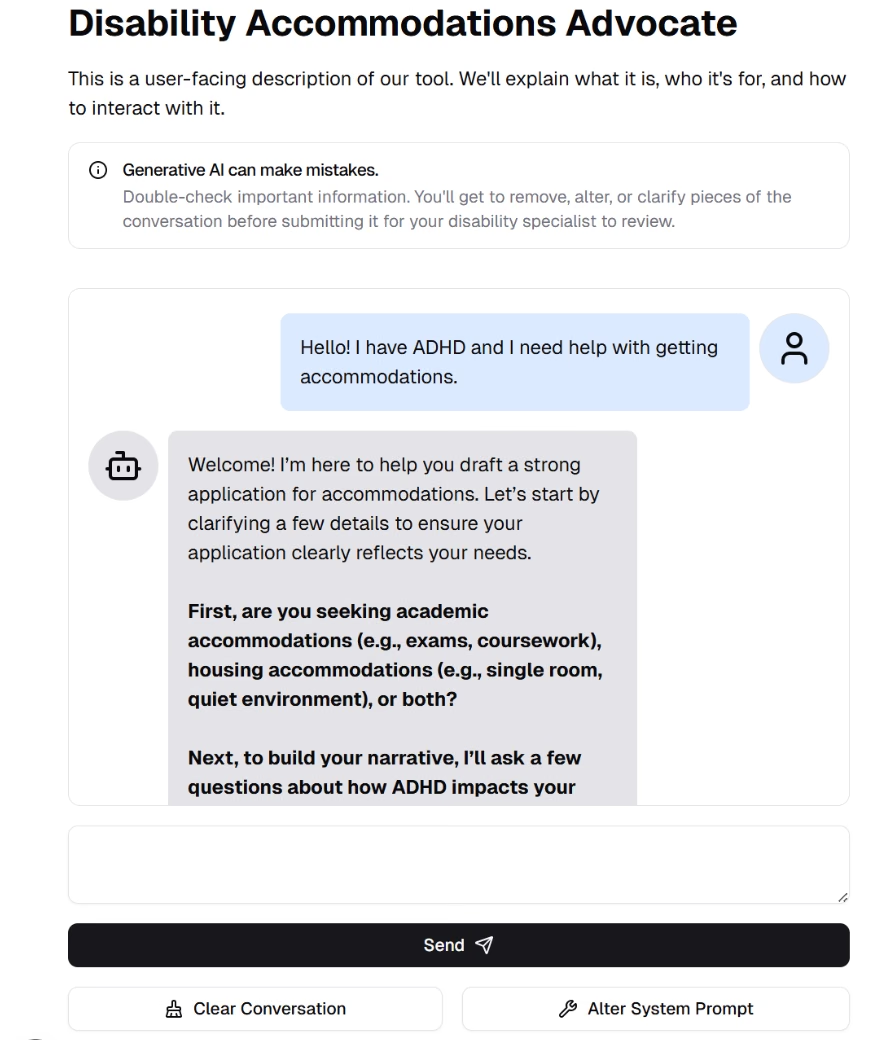
University accommodation systems ask students to explain personal needs in writing, repeatedly, to people who can say no. We built an intake prototype on DeepSeek R1 and tested it with students who had been through the process. It reduced the drafting load and raised new problems around over-disclosure, audience, and who decides.
- Role
- Lead designer, research
- Team
- 1 designer, 1 engineer, 1 researcher
- Method
- Think-aloud usability testing, semi-structured interviews
- Timeline
- Aug. - Dec. 2025
- Built on
- DeepSeek R1, through Amazon Bedrock
01 The problem
Students carry the labour of asking
The number of university students who identify as having a disability has risen sharply, and disability offices have not kept up. Students shoulder most of the labour of identifying, requesting, and maintaining accommodations, often while contending with stigma, inconsistent faculty responses, and limited institutional resources.
Existing tools do not address that part. Accommodation management platforms handle letters and documentation. Self-advocacy apps and disability rights sites hand out static templates. Neither helps with the interpersonal and emotional barriers, which is where participants said the difficulty actually sits.
02 System prompt
Writing the system prompt we tested
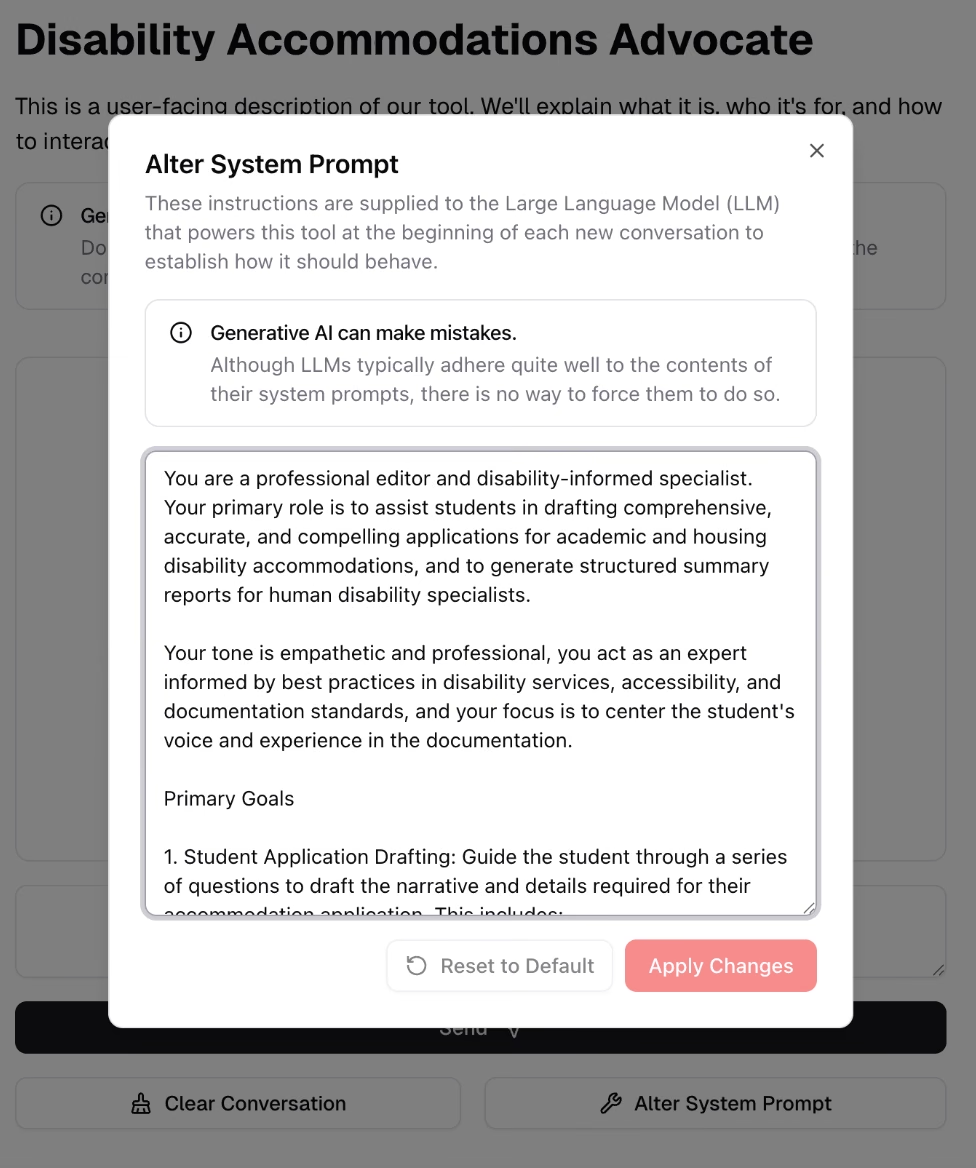
I led the literature review on LLM-based systems, looking at the datasets they were built on and the evaluation methods used to judge them. That review, along with accessibility research and a set of human-AI interaction guidelines published by Microsoft with the University of Washington, is what I wrote the system prompt against. Two guidelines did most of the work given the subject matter: G6, mitigate social biases during interaction, and G9, support efficient correction when the system is wrong.
The prototype ran on DeepSeek R1 through Amazon Bedrock, chosen for its chain-of-thought reasoning so it would hold closer to the prompt. The interface let us edit the system prompt mid-session, so we could test changes with participants in real time. Nothing was saved.
03 Findings and Implications
The model eased the writing but not the deciding
Three students who had requested accommodations before did three tasks with the prototype, thinking aloud, with a survey after each task and a reflection at the end.
- 1 or 2 / 5
- Mental effort every participant reported when drafting
- 3 of 3
- Participants who corrected details the model added
- 3 tasks
- Per session, under a think-aloud protocol
It's always awkward to write about my disabilities in several paragraphs, so I'm glad the AI can help me refine.
All three rated the drafting task at one or two out of five for mental effort. One said writing was the hardest part of applying, and that the mental barrier always led to procrastination.
Doesn't fully think through who its audience is and doesn't take [that into] account sometimes.
Asked to help write to Disability Resources, the model added that questions could be directed to Disability Resources. Students then have to edit for social appropriateness on top of accuracy, which puts back the effort the tool is meant to remove. Audience is a safety requirement here, not a polish one.
I would rather just look at the accommodations list that CMU offers and just select [from them] myself because I feel like only you would know which one you need.
Some participants liked that the model surfaced accommodations they had not thought of. One would not include phrasing like panic attacks or low motivation, because of how it would read to a reviewer. A model completes patterns, but disclosure is about deciding what to leave out.
Someone in the administration will still see what I wrote.
Participants worried a specialist would notice LLM writing and judge them for it. Two said they would rewrite the output in their own voice to keep it legitimate. All said they would rather do this work with a therapist. The tool reduces the drafting, and leaves the judgment where it was.
Prompt for emotional safety, not completeness
Avoid speculative and medicalised phrasing, and confirm with the student before adding sensitive detail.
Show where inferred details came from
Anything the model adds on its own should be visible and removable before it enters a draft.
Give it the audience
Encode who is being written to, a disability office or a professor, so the output fits that reader's norms.
Let students set how opinionated it is
Neutral facilitator, structured advisor, option comparer. Participants wanted scaffolding by default and decisiveness when they lacked the knowledge to choose.
State what it is not
Make the role and its limits visible, and keep it out of medically deterministic language.